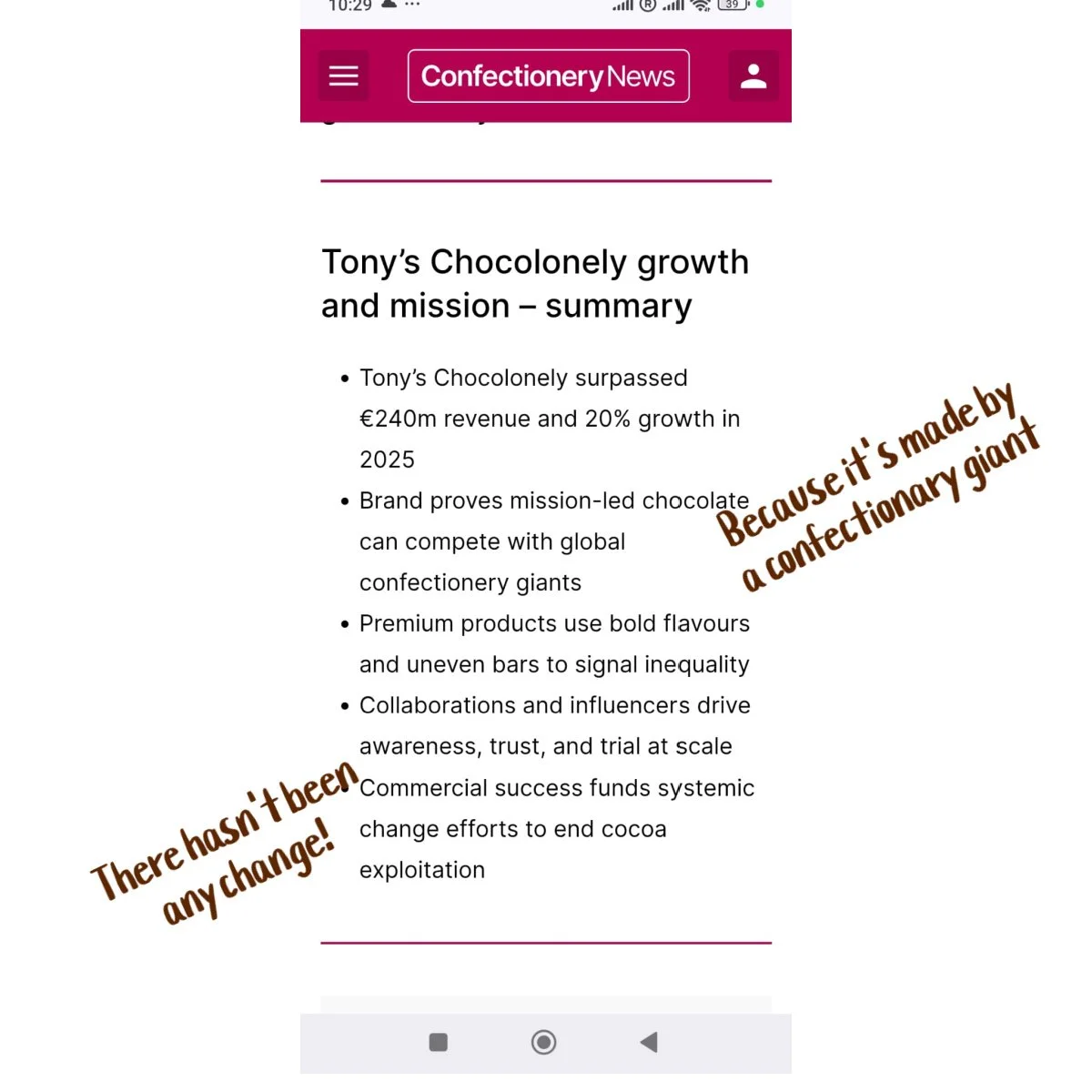
This week, Confectionery News published an article titled “Tony’s Chocolonely: Turning Ethical Chocolate into a Global Hit.” Since then, my inbox has been flooded with thoughtful consumers asking why I’m not celebrating Tony’s as a leader in ethical chocolate. And if Tony’s thinks I am wrong, they are welcome to show me their successes in West Africa. I will be happy to correct my stand.
To answer that, some context is important.
About 18 years ago, I founded Slave Free Chocolate around the same time that IRAdvocates began taking legal action against complicit companies, Miki Mistrati was exposing child exploitation through film, and a group of well-meaning Dutch journalists launched Tony’s Chocolonely. We all shared the same mission: to end child labor and child slavery in the chocolate industry.
Nearly two decades later, the reality is sobering. Very little has changed. Farmers are still living well below the poverty line. Children are still working instead of attending school. Most lack access to even basic emergency medical care when injured on the job.
Before explaining why Tony’s is not included on Slave Free Chocolate’s Ethical Chocolate Supplier list, it’s important to acknowledge their contributions. Tony’s was among the first companies to bring widespread attention to these issues. They’ve done an exceptional job educating consumers and pushing the conversation into the mainstream. They’ve also helped open the door for tools like supply chain transparency technologies. That matters.
In their early days, Tony’s relied on Barry Callebaut to manufacture their chocolate—a company widely criticized for its role in the very system they aimed to change. At the time, I gave them the benefit of the doubt. Their stated goal was to drive change from within, and their awareness efforts were significant.
But a decade passed without meaningful industry-wide improvement. Tony’s continued its relationship with Barry Callebaut, even as hundreds of smaller chocolate makers proved it was possible to produce chocolate ethically and independently.
At a certain point, it became inconsistent with our standards to include Tony’s on the Slave Free Chocolate list. Partnering with a complicit industry giant while failing to achieve measurable progress toward stated goals cannot be considered success. Continuing the same approach for nearly two decades without results is not a win.
My position is simple: recognition should follow results. When we begin to see real, measurable improvements—when farmers are paid fairly, when children are in school, when exploitation is eliminated—then we can celebrate and analyze what worked.
Until then, companies appealing to consumers’ goodwill with narratives of effort rather than outcomes are engaging in marketing, not meaningful change. If we fail to recognize that distinction, the system will remain exactly as it is.