child labor

Tony's Chocolonely: Recognition should follow results, not the other way around.

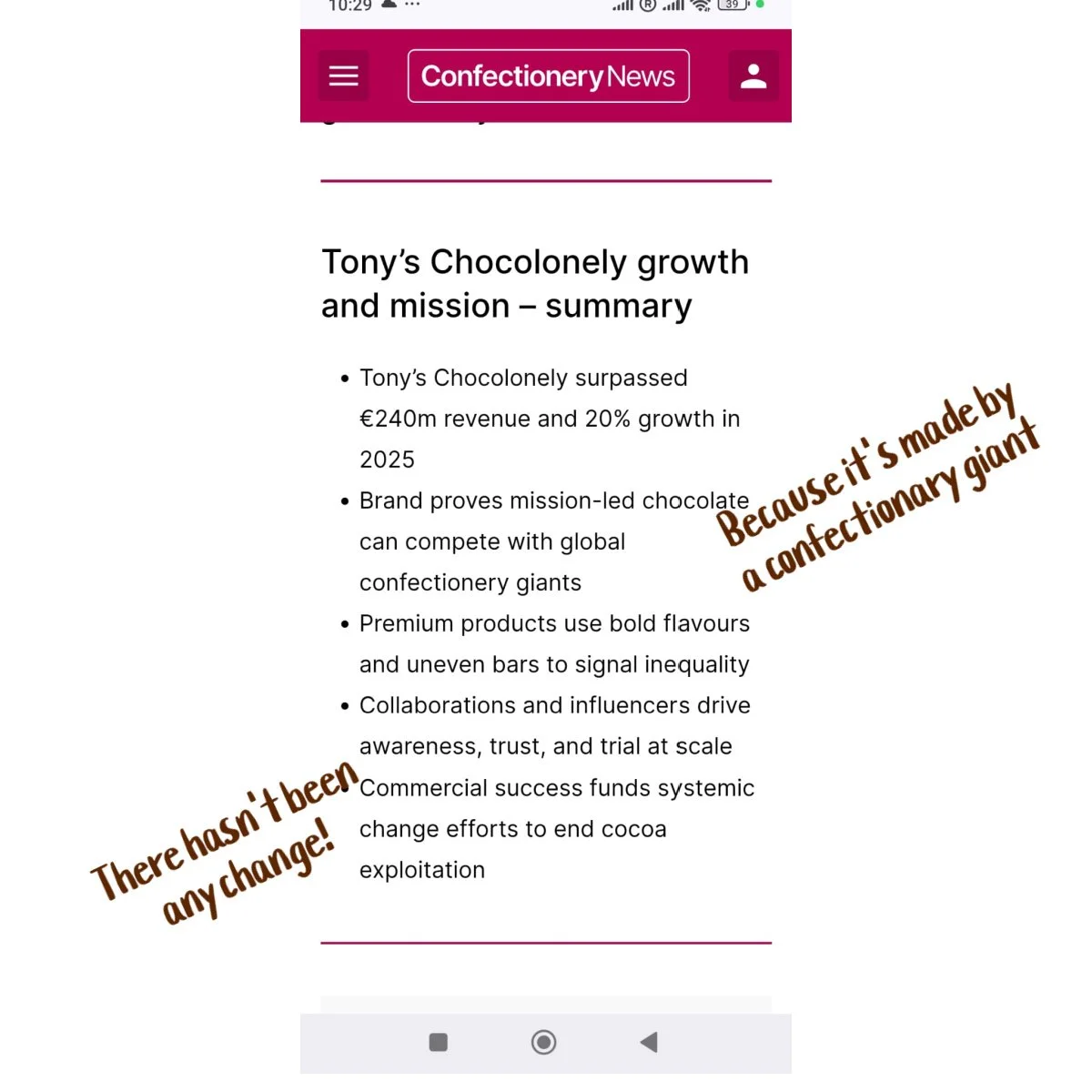
This week, Confectionery News published an article titled “Tony’s Chocolonely: Turning Ethical Chocolate into a Global Hit.” Since then, my inbox has been flooded with thoughtful consumers asking why I’m not celebrating Tony’s as a leader in ethical chocolate. And if Tony’s thinks I am wrong, they are welcome to show me their successes in West Africa. I will be happy to correct my stand.

To answer that, some context is important.

About 18 years ago, I founded Slave Free Chocolate around the same time that IRAdvocates began taking legal action against complicit companies, Miki Mistrati was exposing child exploitation through film, and a group of well-meaning Dutch journalists launched Tony’s Chocolonely. We all shared the same mission: to end child labor and child slavery in the chocolate industry.

Nearly two decades later, the reality is sobering. Very little has changed. Farmers are still living well below the poverty line. Children are still working instead of attending school. Most lack access to even basic emergency medical care when injured on the job.

Before explaining why Tony’s is not included on Slave Free Chocolate’s Ethical Chocolate Supplier list, it’s important to acknowledge their contributions. Tony’s was among the first companies to bring widespread attention to these issues. They’ve done an exceptional job educating consumers and pushing the conversation into the mainstream. They’ve also helped open the door for tools like supply chain transparency technologies. That matters.

In their early days, Tony’s relied on Barry Callebaut to manufacture their chocolate—a company widely criticized for its role in the very system they aimed to change. At the time, I gave them the benefit of the doubt. Their stated goal was to drive change from within, and their awareness efforts were significant.

But a decade passed without meaningful industry-wide improvement. Tony’s continued its relationship with Barry Callebaut, even as hundreds of smaller chocolate makers proved it was possible to produce chocolate ethically and independently.

At a certain point, it became inconsistent with our standards to include Tony’s on the Slave Free Chocolate list. Partnering with a complicit industry giant while failing to achieve measurable progress toward stated goals cannot be considered success. Continuing the same approach for nearly two decades without results is not a win.

My position is simple: recognition should follow results. When we begin to see real, measurable improvements—when farmers are paid fairly, when children are in school, when exploitation is eliminated—then we can celebrate and analyze what worked.

Until then, companies appealing to consumers’ goodwill with narratives of effort rather than outcomes are engaging in marketing, not meaningful change. If we fail to recognize that distinction, the system will remain exactly as it is.

No, Tony's is still not on the Slave Free Chocolate (org's) List of Ethical Suppliers

Why is Tony’s Chocolonely still absent from the Slave Free Chocolate List still remains a frequent inquiry in my inbox.

Initially, Tony’s Chocolonely earned recognition on the Ethical Chocolate Company’s List due to their commendable efforts in raising awareness about the issue of child and slave labor in cacao production. Despite operating ethically themselves, their partnership with Barry Callebaut, a complicit giant in this matter, gave them a pass in acknowledgment of their public stance against slavery in the chocolate industry.

In 2007, ethical chocolate makers were scarce, and Tony’s emerged as a pioneer, advocating change in the industry. However, despite their promises and efforts to initiate industry-wide reforms starting with Barry Callebaut, they've remained steadfastly independent in their approach, leading to their isolation – hence the "Lonely" in Chocolonely.

While initially left on the list due to their promises, the lack of tangible industry changes, the persistent use of child labor, and their continued association with Barry Callebaut led to questions from other ethical companies. Their absence from the list continues as the industry remains unchanged, with rising child labor and merely superficial commitments to sustainability and labor practices.

Despite numerous announced initiatives by companies profiting from child and slave labor, none have produced meaningful results. The underlying issue is the inability to ensure a true living wage for farmers, leading them to resort to unpaid child labor, while the industry strives to keep cacao prices at rock bottom.

The conclusion is clear: consumer-facing marketing claims unravel to reveal no substantial impact, leaving consumers susceptible to being "brandwashed." Until significant tangible changes are witnessed or an assurance of ethical practices throughout their operations is evident, Tony’s Chocolonely remains excluded from the list.

Slave Free Chocolate is committed to showcasing the chocolate companies that are Ethical the Whole Way Through. If you are one of these companies and not on our list, please contact us.

Brazil court fines Cargill in case involving child labor on Cocoa Farms by By Marcelo Teixeira and Ana Mano

SAO PAULO, Sept 26 (Reuters) - Commodities trader Cargill has been ordered by a Brazilian court to pay 600,000 reais ($120,185) as indemnity for buying cocoa from farms where child labor or forced work has been identified.

U.S.-based Cargill said on Tuesday it disagreed with the complaints and fine and would appeal the ruling to a higher court.

According to a decision dated Sept. 18, seen by Reuters, from the 39th Labor Court in the northeastern state of Bahia, Cargill was also ordered to add to its contracts with Brazilian cocoa suppliers clauses to end the commercial relationship if child labor or other unlawful working conditions occur.

Read the rest of the article HERE

SUSTAINABILITY INITIATIVES IN THE COCOA INDUSTRY by Bright Adjei Debrah

SUSTAINABILITY INITIATIVES IN THE COCOA INDUSTRY by Bright Adjei Debrah

The sustainability issues in cocoa are multidimensional and complex. Farmers are getting older, and they tend to be on small farms with large families, they work on the farm with very little to no external paid labor and they don’t have very big harvests. They also have a dropping productivity rate and they have murky land tenure rights. That combination often leads to encroachment into protected lands and forests. Poverty also leads to children needing to contribute to the family income by working on the farms but often by engaging in illegal child labor. Illegal child labor means things like carrying really heavy loads, using dangerous materials like machetes, or using chemicals and they are missing school or not going to school at all.

The latest numbers we have are that more than 2 million children are engaged in illegal child labor on West African cocoa farms. Smallholder farmers also have very little say in the prices that are paid for cocoa, actually pretty much none because the government set the price of cocoa. The farmers are very dependent on their local bean collectors (purchasing clerks) for the timing of when they pass by the farm to collect the seeds. The price that they get paid for the cocoa beans is way too low to earn a living income.

If we as a society want real economically stable societies that are linked up to the global food chain, then that is something that needs to change. Earning a living income is a basic human right that has been agreed upon with the UN as one of the global sustainable development goals, and cocoa farmers are far from it because most West African cocoa farmers are under a dollar a day.

The manufacturing process is very fractured, and this fractured process leads to enmity, when what we really need in the cocoa value chain is connection, empathy, and responsibility.

If we want to change the cocoa industry, and that I mean the entire cocoa industry, we have to look at how cocoa flows through 99% of the chocolate you have ever consumed in your life, and would probably continue to consume because only at scale will we achieve a significant impact on the ground. For now, we are doing much too little, much too late, and much too slowly.

SO HOW DO WE ACHIEVE THAT CONNECTION?

Connection comes through traceability. Chocolate brands have the obligation to know exactly who the cocoa farmers are, and who are providing the cocoa beans for their chocolate. Only then can they understand their circumstances and actually take full responsibility towards them for the human rights and the planet rights that we are all working towards.

Empathy is putting yourself in another person’s experience within their frame of reference. Farmers don’t want to ruin the last standing forest in their country, and farmers don't relish watching their children carry heavy loads, miss school or not go to school.

There is a systematic inequality that exists in the cocoa supply chain that is causing this exploitation. What is happening here in the cocoa-growing regions in Africa is a symptom of how stakeholders approach issues at their end. If stakeholders don't connect, empathize, and take responsibility for what is happening here in the cocoa-growing regions in Africa, then directly or indirectly, they are responsible for deforestation, exploiters, and child traffickers.

The cocoa value chain is shaped like an hourglass ⌛️. You’ve millions of cocoa farmers, mostly smallholders on one side, and on the other are billions of chocolate consumers. In the middle are just a few chocolate giants or stakeholders. The chocolate market is dominated by a few chocolate manufacturers, cocoa processors, and traders. These few actors have all the powers in the supply chain and great power comes with great responsibility. These stakeholders therefore have arapid goal-oriented and collective approach to changing the system.

Here is an interesting thing that is happening. Currently, there are more than 50 active separate sustainability initiatives or programs that are going on in Ghana and Côte d’Ivoire alone. A lot of these initiatives are focused on the same groups of farmers but with little to no cohesive approach between the programs, meaning that not a single farmer is being pulled out of poverty. Many of the farmers are also left in the cold and not being engaged at all.

What is happening is that chocolate giants are competing with each other and protecting their sustainability initiatives and they are doing it for just a very small fraction of the supply chain.

WHAT CAN BE DONE ABOUT THIS

Collaboration is the best new form of competition. Because, in this sharing economy, isn’t collaboration on sustainability programs much more purposeful than competition? As stake holders, we already know what the tools are to connect to farmers and to engage, but we need to do it together so that we can make a positive impact much faster.

As an example, picture a farmer who has been asked to have a map made of his farm. You can make GPS polygon maps by walking the perimeter of the farm and taking coordinate points. These marks are very important to both the farms and the farmer groups as well as the buying companies. Farmers and farmers groups can make an assessment of current yields, potential yields, and collective purchases for example of fertilizers/seedlings they might need for the year and buyers can analyze the maps for deforestation and deforestation risks. The maps are important and a tool that we know.

Picture the farmer welcoming a person with a company logo onto his farm to come and walk the perimeter of the farm. Then picture a week later, a different person with a different company logo came to do the exact same work again. Picture something that is even more frustrating than that wasted time and that duplicated effort. The frustrating part is that the farmer or the farmer groups do not even own, see it, use it, or leverage it.

Another connection, and collaboration that chocolate brands need to do is on living income. Chocolate brands can and should collaborate on paying a price to farmers that enables a living income. It is not fair for one chocolate brand to carry that financial burden for all other chocolate brands. It is also not a good idea for a farmer or farmer groups to sell their entire harvest to just one buyer or buying company. That is not resilient, that is risky business. It is not a good idea. But if you are only selling a fraction of your harvest at a living income price, the price that enables living income, then you are never going to get out of poverty.

There should be a level playing field amongst consumer brands to lift farmers out of poverty to create wealth. When that happens, farmers can make the investment in their farms, that chocolate companies say they need to do. Farmers would invest in their families, farms, and children’s education but without resources, they cannot do that. Chocolate brands and stakeholders that realize this connection, this empathy, and this responsibility can achieve that opportunity to amplify their positive impact on the ground through collaboration. If they are transparent about it, then consumers would know which chocolate brands to award with their chocolate buying sense.

To be clear, chocolate companies should compete fiercely on delicious chocolate, but they should not compete on cocoa. There should be no competition for child labor, deforestation on poverty, community development, additional livelihood programs, etc.

Consumers should award the chocolate brands that make farmers and forest protection their priority, and not a unique selling point, but something that is an absolute baseline.It is not a race we should be competing with each other, but it’s something that we should be doing together, so that we can get to where we are going faster.

The true cost of chocolate- Article from the GlobeandMail. May 12th 2023

The true cost of chocolate by GEOFFREY YORK AND ADRIAN MORROW


Labels for ‘sustainable’ cocoa can hide harsh realities for farmers trying to earn a living and eliminate child labour. In Africa and Latin America, The Globe spoke with growers on the front lines of global price wars.Canadian consumers, seeing labels that boast of “100-per-cent sustainably sourced cocoa” on many of the most popular chocolate products in Canada’s supermarkets, might never imagine that hunger and poverty are the grim daily reality for millions of cocoa farmers in Africa and Latin America.

Sustainable cocoa – a promise of all the major cocoa and chocolate companies – is vaguely defined and can include anything from training and education programs to a variety of supply certification schemes that pay premiums and attempt to trace cocoa origins. But at the heart of the sustainability concept is a pledge by the major manufacturers to help farmers gain a decent income. The promise is crucial to their marketing: a reassuring signal to consumers that a chocolate purchase is an ethical one.

READ THE REST OF THE ARTICLE


Bibamba Chocolate Announces Results of Heavy Metal Testing

Bibamba Chocolate Announces Results of Heavy Metal Testing February 22 nd , 2023

Careful Agricultural and Fair Labor Practices Make Safer Dark Chocolate

Denver – February 22 nd , 2023 –Denver artisan chocolate company Bibamba Chocolate

announced today the results of heavy metal testing of their signature dark chocolate

bark.

The presence of high levels of heavy metals such as lead and cadmium found in dark

chocolate has become an issue of growing concern to dark chocolate consumers. First

reported by Consumer Reports in December 2022, many major news outlets have

reported that several large dark chocolate brands tested high in heavy metals, leaving

dark chocolate lovers wary about the safety of their beloved snack.

Bibamba Chocolate owners Patrick and Mara Tcheunou, who have prioritized

sustainable farming and fair labor practices at their family farm in Cameroon since the

inception of their company, responded quickly to this growing concern about heavy

metals in dark chocolate. They had their signature dark chocolate bark “Noir 60%

Cacao” independently tested by a certified food testing laboratory in early February.

The owners were happy, but not surprised, to learn that Bibamba’s chocolate tested

below the acceptable levels of lead and cadmium, according to California's

maximum allowable dose (MADL). The MADL is currently the most protective

standard in the industry.

“I credit this to our good farming and post-harvesting practices by our farm employees,

who are well compensated, thus are incentivized to follow best practices and

procedures,” Patrick said, referring to the harvesting, fermentation and drying of cacao

beans involved in the manufacture of Bibamba’s chocolate. “Lead is likely deposited on

cocoa beans through dust, mostly during drying.”

Bibamba Chocolate is recognized as Slave-Free Chocolate, meaning they do not use

child labor (which is common in the chocolate industry) and pay their farmers fair wages

and healthcare. This investment is not only the right thing to do – it has also resulted in

better cacao making Bibamba dark chocolate both delicious and safe to eat.

Chocolate, café y té 'Comercio Justo': El fraude más grande del siglo

Por

Fernando Morales-de la CruzFounder of Café for Change13/07/2019 09:44am CEST

La Coordinadora Estatal del Comercio Justo, la red mundial de la organización Alemana Fairtrade International, la Comisión Europea y también organizaciones del sistema de Naciones Unidas y ONG como Oxfam y Cáritas hacen creer a periodistas, a políticos y a los consumidores que “con el ‘Comercio Justo’ colaboramos con el desarrollo de las comunidades del Sur” cada vez que consumimos un chocolate, un café, un té, etc, supuestamente certificado como “Comercio Justo”.

Es absolutamente falso que “con el ‘Comercio Justo’ colaboramos con el desarrollo de las comunidades del Sur”.

En su testimonio en el Parlamento Europeo Ange Aboa, corresponsal de Reuters para África del Oeste y Central, dijo que el sistema de certificaciones Comercio Justo/Fairtrade, UTZ y Rainforest Alliance “son el fraude más grande del siglo” (“La plus grosse scroquerie du siecle”). Es posible escuchar el testimonio de Ange Aboa en francés aquí.

Read the rest of the article

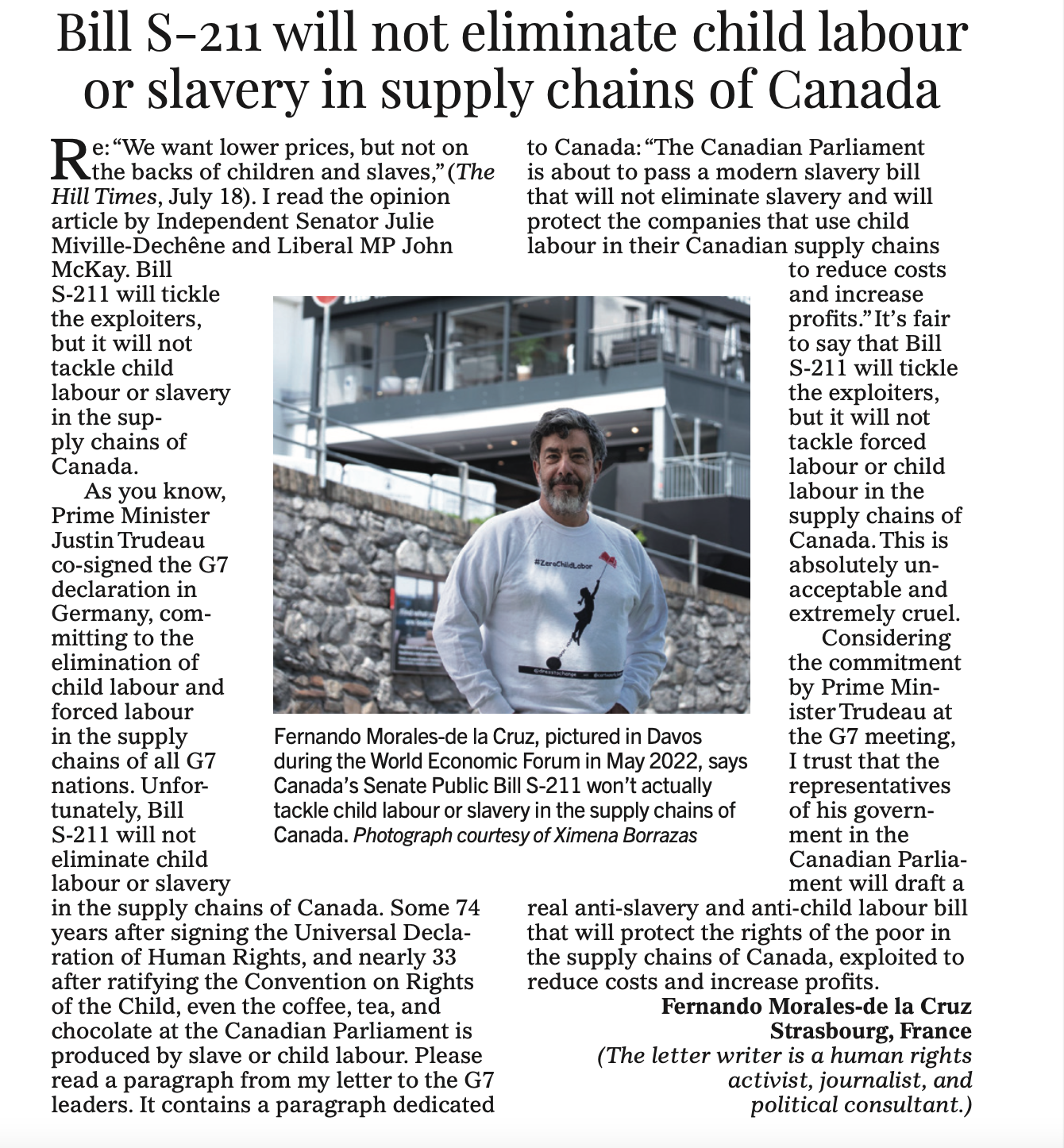
The Hill Times letter to the Editor August 8th 2022 by Fernando Morales-de la Cruz

There are various initiatives being proposed going on at the government lever in the US, Canada and the EU. None of them are written prioritizing the children they are claiming to help. All are prioritizing the corporate lobbies. Here is one regarding a Canadian proposal.

Slave Free Chocolate's Halloween 2022 Letter to the public.

In the week leading up to Halloween 2022 90 million pounds of chocolate will be sold in the US alone. The vast majority tied to child labor and slavery. Not only has the industry known of this for 21 years now, but they also promised to remedy this situation when they all signed the Harkin Engel Protocol​ in 2001.​  The first milestone was set for 2005. I founded Slave Free Chocolate.org just a few years after the 2005 milestone was horrifically missed and no one seemed to know anything about this situation. Chocolate is a treat; therefore, we the consumers have all the power to change this. Though we’ve caused a lot of flurries, the only news that isn’t fake is that the dial hasn’t moved in the right direction. Sadly, the last report sponsored by the US Department of Labor has the number of exploited children increasing. When Slave Free Chocolate was started the number was estimated at 800,000 it is now 1.6 million.


Before I delve deep into this State of Halloween Address, I feel I must first clarify what the activist community is referring to when talking about child labor​ i​n the cocoa sector. Especially in the developing world, it is normal to help your parents. This could be a part-time job after school or perhaps helping them with the corner market they own before and after school or having a big list of chores on the family farm after school and on the weekends. The operative word here is “school”.  The children we are fighting for aren’t going to school as their parents can’t A. afford to send them, and B. can’t afford to replace that child with a paid adult laborer. These children fall under what the UN has defined as ​The ​Worst Forms of Child Labor. In the case of cocoa, these children aren’t going to school, don’t have access to medical care, work with toxic chemicals, and machetes that are illegal for children to use, and lift weights too heavy for their growing frames. Additionally, a percentage of these 1.6 million children are trafficked in from poorer countries like Burkina Faso and Mali. These children are coerced and trafficked with the hope of getting paid for their work and sending money home to help their families. This is not the case; they aren’t getting paid. They are slaves.


Why​ are there 1.6 million children illegally harvesting our cocoa?​ The simple answer is that the farmers haven’t received a price increase for their beans since the late 70s. In The Ivory Coast, they are reported to be making $.75 cents a day, and in Ghana just a bit over $1. This is less than 1/2 of what is considered the poverty line. Not only has this 21-year cycle of abject poverty resulted in horrific child labor problems, but there is also a large negative environmental impact as well. The planet has lost 90% of an important rainforest. 


The question of why the industry hasn’t paid a living wage is the $64,000 question. True, dealing with governments in developing countries is plagued with challenges. But industrial cocoa is the biggest client of Ghana and The Ivory Coast. When you add to that, we are talking about a $100 Billion-dollar industry, it seems the power is there. The problem is that the intent isn’t. It must really boil down to profit over promises. Promises not only made to these children but to the world.


The industry has responded to consumer outrage with various initiatives and more promises while the goalposts continue to move into the future. Perhaps some of these initiatives could have merit but only if they are on top of paying the farmers a living wage. Without that, they are just marketing ploys to protect their brands. Even this week one chocolate company issued a report card, of course putting them on top. None of this is verified. It’s all a case of the fox guarding the hen house. I think you can safely claim that since the dial hasn’t been moved in the right direction, everything tried to date has failed. 


One thing that I consider to be good news is that the generic claims of “sustainability” and “traceable” have started to run their course. Consumers are waking up to the fake news associated when they see either of these words on websites and/or packaging. Remember that everyone in this industry is monitoring themselves. “Traceable” is a verb, not a guarantee that good things are at the end of the line. Journalists of the UK’s Channel 4’s piece Cadbury Exposed followed Cadbury’s traceable line to a farm where no children were going to school and horrific cuts from machetes weren’t treated in a clinic. Why? The farmers couldn’t afford any of that.  Of course, we all want everything to be “sustainable” but what does that really mean? Currently, the definitions are set by individual corporations. More of the fox guarding the hen house. There is good news in this regard. Consumers are getting wise to the emptiness of these claims and there is now an opportunity to introduce labeling that defines what “sustainable” means and how that product ranks. 


​Additional good news is that there are lawsuits filed that need our awareness of and support. International Rights Advocates is the place to immerse yourself with this information and ways you can help.


In the meantime, we need to keep pressuring the industrial chocolate companies to pay a living wage and ​open themselves up to independent auditing when they make their claims of doing all they can. Basically, fulfill the promises they not only made to these children but to the world. 


For ways to get into action, visit slavefreechocolate.org. Have a Happy Halloween!


Ayn Riggs

Director

Slave Free Chocolate

Slavefreechocolate.org

Email

Documentary maker Miki Mistrati wants consumers to know the truth about chocolate

New film: "There is no role in cocoa production that is safe for the 1.56 million children working in West Africa"

by Lise Colyer March 29, 2022 in Society, Business, Features, Governance

Miki Mistrati has been documenting child labour in West Africa’s cocoa industry since 2007 – and he’s in therapy.

“You never get used to this,” he says. “I want people to understand what they are a part of. If you want to buy a cheap chocolate bar supporting child labour that’s your decision, but don’t tell me that you didn’t know.”

Research accepted by the cocoa industry says that 1.56 million children are working in cocoa production in Ivory Coast and Ghana. According to Miki Mistrati’s latest documentary film The Chocolate War, a high proportion of them have been trafficked from neighbouring countries such as Burkina Faso and Mali.

READ FULL ARTICLE HERE