Press Release: Child Slaves Who Were Trafficked and Forced to Harvest Cocoa in Cote D’Ivoire Sue the Cocoa Companies that Enslaved Them: Nestle, Cargill, Mars, et el.

Fri, 02/12/2021 - 09:46 -- admin

Contact: Terry Collingsworth, Executive Director
tc@iradvocates.org 1-202-543-5811 @tpcollingsworth

The Complaint filed today and the full press release are attached below.


On February 12, 2021, IRAdvocates filed a federal class action lawsuit on behalf of eight Malian young men who managed to escape back to Mali after being trafficked as children and forced to harvest cocoa in Cote D’Ivoire for one or more of the Defendant companies, Nestle, Cargill, Mars, Mondelēz, Hershey, Barry Callebaut, and Olam. These companies have a long history of violating the law and participating in a venture in Cote D’Ivoire that relies upon child slaves to produce cheap cocoa. In 2001, they signed the “Harkin-Engle Protocol” in which they explicitly promised consumers and regulators they would stop using child labor by 2005. Instead, they have given themselves numerous unilateral extensions of time and now claim that by 2025 they will reduce by 70% their reliance on child labor. Rather than make progress, their use of child labor is actually getting worse. In late 2020, a study by NORC at the University of Chicago and funded by the U.S. Department of Labor concluded that 1.56 million child laborers were working in cocoa growing areas of Côte d’Ivoire and Ghana in the 2018/19 growing season, an increase of 14 percent since a 2015 study, and 1.48 million child laborers engaged in hazardous work during this period

Terry Collingsworth, Executive Director of IRAdvocates, which represents the eight Malian Plaintiffs, stated “By giving themselves this series of extensions, these companies are admitting they ARE using child slaves and will continue to do so until they decide it’s in their interests to stop. Based on the objective record of twenty years of the failed Harkin-Engle Protocol, these companies will continue to profit from child slavery until they are forced to stop. The purpose of this lawsuit is to force them to stop. Enough is enough! Allowing the enslavement of African children in 2021 to harvest cocoa for major multinational companies is outrageous and must end.”


The case filed today is based primarily on the Trafficking Victims Protection Reauthorization Act (“TVPRA”), 18 U.S.C. § 1595 et. seq. This law allows victims of trafficking and forced labor to sue companies that participate in a “venture” and benefit from the trafficking or forced labor. The named Defendant companies have been cooperating in a venture for decades as they collaborate in a scheme to continue using child slaves while jointly promoting bogus programs they falsely claim are solving their child labor problem. They benefit by continuing to profit from selling cheap cocoa harvested by child slaves, including the eight Plaintiffs who filed this case. The TVPRA makes the companies jointly liable for child slavery on behalf of the “venture.”

IRAdvocates also filed a case on behalf of six former child slaves against Nestle and Cargill under the Alien Tort Statute (ATS), 28 U.S.C. § 1350, in 2005. The case is still pending and was argued in the Supreme Court on December 1, 2020. The companies argued they are immune from liability for child slavery under international law. Collingsworth commented, “in filing this new case we want these companies to know we will use every possible legal tool available to make them stop abusing child slaves. We call upon the companies to work with us solve this problem, rather than spend millions in legal fees to fight an uncontestable fact – the cocoa industry is dependent upon child labor. ”
The full complaint of the new TVPRA case as well as information about the ATS case are available at www.IRAdvocates.com. Here is an article detailing the situation the cocoa slaves endure: https://www.justsecurity.org/73959/nestle-cargill-v-doe-series-meet-the-...
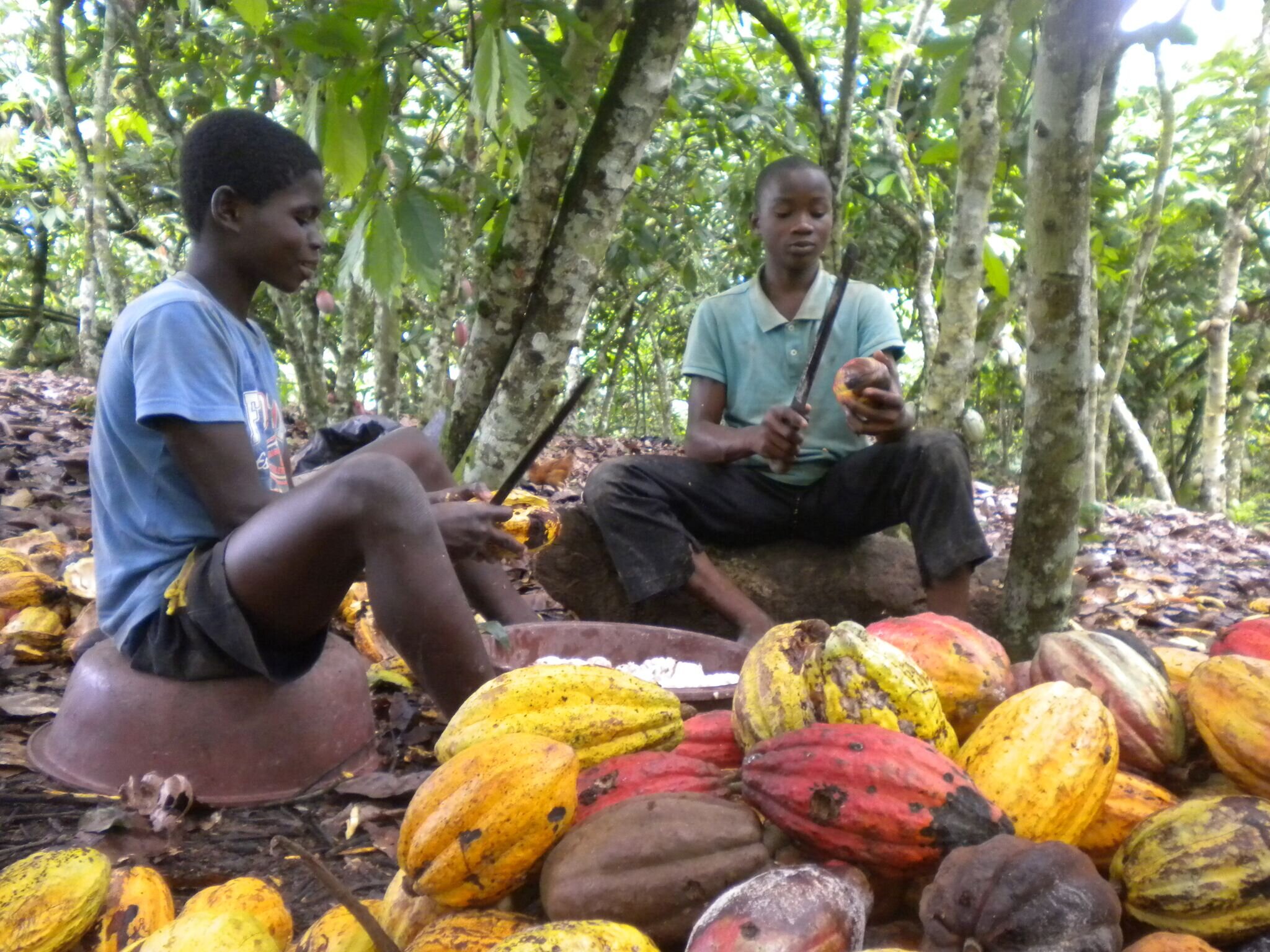
 

www.IRAdvocates.com

COCOAKIDS7.JPG

A Case Against Big Chocolate by Clay Gordon of The Chocolate Life

“Big Chocolate” gets hauled into court for failing to live up to its promises to curb human trafficking in their cocoa supply chains.

Before the sun rose on the Capitol this morning, Friday February 12th 2021, the non-profit organization International Rights Advocates filed suit in the US District Court for the District of Columbia on behalf of eight former child slaves of Malian origin who were trafficked from Mali and subjected to forced labor harvesting and cultivating cocoa beans on farms in Côte d’Ivoire.

Click here to read the rest of the article The Chocolate Life

Ivory Coast cocoa farmers threaten to boycott industry sustainability programs by Ange Aboa for Reuters

YAMOUSSOUKRO (Reuters) - Cocoa farmers in Ivory Coast said on Thursday they would withdraw from chocolate industry sustainability programs if companies try to avoid paying a premium aimed at combating farmer poverty.

The world’s top producer introduced a $400 per tonne premium this season, known as a living income differential (LID), to increase farmer wages.

The move was welcomed by farmers, but it has driven up prices for Ivorian cocoa just as the coronavirus pandemic dents global demand, causing friction between large chocolate companies and the workers growing the raw crop.

At stake are the sustainability schemes that certify that the cocoa that international companies buy is free of environmental and human rights abuses.

They allow companies to market their chocolate as ethically produced and charge more for it, although the schemes cover less than half of Ivory Coast’s cocoa exports.

READ THE REST OF THE ARTICLE HERE


Do You Really Want Change?--By Erin Andrews of Indi Chocolate

Do You Really Want Change?

Many of the familiar candy bars we’ve grown up with, passed out for
Halloween, and chocolate we’ve baked into holiday treats, contain
ingredients created by enslaved child labor. This candy is available
now at a store near you, but the low, low prices are only possible
because of business practices that would turn your stomach.

Lawyers representing Nestle and Cargill were in the Supreme Court
yesterday because the companies for decades chose ingredients that
they knew were grown and processed with enslaved child labor.

The largest, most profitable multinational chocolate corporations
confirm they were aware the children were working without pay or
liberty, and that they were not working on their own family farms.
These corporations have publicly confirmed that they are buying
ingredients that they know use internationally trafficked children.

The case before the Supreme Court is not about whether these practices
exist today, or who knew about them. The question is why these large,
profitable US corporations have been able to get away with this for so
long without accountability or consequences.

They have long acknowledged the problem but have made no meaningful
progress in solving it, despite having the resources to do so.

Let’s be honest. Choosing to not take action will continue the problem
It doesn’t resolve it.

Choosing profits over ethics prolongs unacceptable colonial traditions.

Can we, as Americans, finally acknowledge that these corporations are
not going to change unless there are consequences? At what point is
the cost of not actually doing what is ethical, decent and right
become too much, unacceptable and intolerable? These corporations are
making conscious choices to see how long they can get away with it.

At what point do the corporation’s continued broken promises and lack
of meaningful action have consequences? How long are we going to allow
them to get away with this?

These are important questions the Supreme Court and US citizens need
to address right now.

This case before the Supreme Court is about making these corporations
accountable and having consequences for not really doing anything
about it. Shouldn’t there be consequences if that is the only thing
that will finally make these corporations do what they promised and
could have changed long ago?

These US corporations shouldn’t be exempt from laws and accountability
because they pretend that they are going to resolve this issue at some
date pushed further and further into the future when all they have
proven to us so far is they have made a choice to try to get away with
it for as long as they can.

Shouldn’t the US judicial system hold these US corporations legally
accountable for their actions (and knowingly choosing to not take
meaningful action) even when they occur out of sight in a faraway
country?

When is the US Justice System, and laws of our nation that make the US
such an economic powerhouse, going to give these corporations
meaningful consequences so they will finally make the change?

When US corporations enjoy the many benefits like freedom of speech,
laws and judicial process that are fundamental to doing business (such
as enforceable contracts and reliable, dependable financial
institutions), as well as use of our public assets (from our taxpayer
investment in roads, bridges, and airwaves to defense spending
investment that created GPS and the Internet they use), shouldn’t
these corporations also be held responsible too?

Here is our opportunity to do what is right. Our US corporations
should reflect American leadership and values.

America has a choice to make. This is our time to lead and not follow.

Please let our US Supreme Court justices know how important our
integrity and values are as a nation, a people and a US corporation.
Let us be leaders of doing what is right so we can hold our heads
high.

If you would like to support more ethical chocolate companies, put
your money where your mouth is and vote with your dollars,
www.slavefreechocolate.org has many suggestions.

Erin Andrews
Founder and CEO of indi chocolate (Seattle, WA)
Co-Founder of Cotton Tree Chocolate (a Belize company)

How Cheap is that Chocolate in the Window? by Ayn Riggs

How cheap is that chocolate in the window?- Ayn Riggs, Director of Slave Free Chocolate. 


On December 1st the oral arguments for Doe. vs. Nestlé and Cargill will be presented to the Supreme Court of the United States. This case goes beyond simply seeking justice for children who were trafficked and held in slavery It will determine if American corporations are entitled to receive immunity if human rights abuses occur in their supply chains outside of the U.S. If Doe (boys, trafficked in from Mali and sold into slavery to work the cocoa farms of Côte d’ Ivoire) wins, then the United States will show the world that the US is on the side of the high ethical standards an humanity that we promote in our values. If Nestle and Cargill win, we are telling the world that slavery is trending again; turn a blind eye and enjoy consumer chocolate and other consumer goods at rock bottom prices. 


At first glance it might be easy to side with these corporations. Maybe, we hope, these large companies were unaware of the fact  that child slaves were  used to harvest the cocoa that ends up in our chocolate bars.  Go to any of the big chocolate company websites (Nestlé, Mars, Hershey Cadbury etc.) and you will find whole sections stating their ethical stance on sustainability. You will find photo after photo of happy farmers and smiling children donning school uniforms in company-built schools with big smiles on their faces and schoolbooks tucked under their arms. You will find they are part of an NGO called the World Cocoa Federation that is making all of this happen. Nothing looks amiss. Why would one question this? Why would they go through all of this work to deceive?


The answer is profit. Most of the big chocolate companies have shareholders. A CEO’s number one priority is profit. Any wrinkle in an effective profit strategy and the CEO will likely lose his or her job. The horrors of illegal child labor and child slavery were exposed in the late 1990s. , Congressional Representative, Eliot Engel, suggested a stamp on chocolate bars; “Child Slavery Free” so consumers would know what they were buying. To thwart this legislation, big chocolate companies including but not limited to Mars, Nestle, Cargill, Hershey and Cadbury all signed a non-binding protocol (Harkin Engel Protocol) in 2001 in which they admitted to knowing that they were profiting off the backs of children who were not going to school, were far from emergency medical services, were working with dangerous pesticides and that many were being trafficked into the cocoa farms from Mali and Burkina Faso and sold as slaves. They promised to clean all of this up. They formed an NGO, the World Cocoa Federation, which would act as the vehicle of remediation. The problem is that they didn’t fund this properly, so it acted merely as a public relations platform by funding paltry initiatives to provide photo ops for websites, with an aim to keep investigative journalists and activists in the dark. Big chocolate has been playing a cat and mouse game with many informed and enraged consumers, activists, and investigative journalists for the last 20 years. Sadly, they are winning. According to the U.S. Department of Labor, the number of exploited children has only increased since the Harkin-Engel Protocol was signed. 


I’ve watched all of this closely for the last 15 years. I founded Slave Free Chocolate.org to bring consumer awareness to the inhumane treatment of these two million children. 


Fair-trade initiatives have the right idea but have failed to make a large enough dent to bring forth any change. Remediation has to include the large companies profiting from the situation. They have the money and power to make a difference and fix it. 


Now we are right up on the end of Doe. vs. Nestlé and Cargill. What it comes down to is clear. Are we as a country going to be patting the backs of corporations for sticking to the strategy that puts a few more pennies in shareholder’s pockets? Or we are going to lead by example that humanity counts; that children matter. 


As consumers we DO have the power to help these children.  It is time we use it. Write to the complicit chocolate companies and your legislative representatives.  Let’s  engage our hearts for this cause and our voices on our social media audiences. You can find a list of offending companies, more details of the situation,  and other ways to make your voice count on SlaveFreeChocolate.org. 


Ayn Riggs is the founder and director of Slave Free Chocolate, slavefreechocolate.org @slavefreecocoa on twitter. 


Nestlè & Cargill v. Doe Series: Corporate Liability, Child Savery and the Chocolate Industry

This story is by Chris Moxley of Just Security:

The world’s chocolate supply is undergirded by rampant practices of child labor under extremely hazardous conditions and, in some cases, slavery. According to the U.S. Bureau of International Labor Affairs, cocoa plantations in Côte d’Ivoire and Ghana combine to produce 60 percent of the world’s cocoa. These plantations rely heavily on the labor of 2 million children working in hazardous conditions. Thousands of these child laborers are trafficked or forced into the work and may not be compensated for their labor, conditions amounting to slavery.


Read rest of the story HERE

NORC revises its figures on child labour in West Africa’s cocoa sector after intervention by chocolate industry

The numbers of children caught in illegal child labor are still extremely high and don’t come close to what the big chocolate companies promised. This is an article that leads to the NORC report from Confectionary News.

Long-awaited US government-funded report from National Opinion Research Center at the University of Chicago (NORC) that assesses progress in reducing child labour in Côte d’Ivoire and Ghana’s cocoa regions shows figures are lower than previously thought (1.56 million compared to estimates of 2.1 million in 2013/14) but it is still a sobering read for the chocolate industry, despite some signs of progress in trying to eradicate the issue.

HTTPS://WWW.CONFECTIONERYNEWS.COM/ARTICLE/2020/10/19/NORC-REVISES-ITS-FIGURES-ON-CHILD-LABOUR-IN-WEST-AFRICA-S-COCOA-SECTOR-AFTER-INTERVENTION-BY-CHOCOLATE-INDUSTRY 

The Supreme Court Grants Request by Nestle and Cargill to consider Giving Corporations Legal Immunity From using Child Slaves.

THE SUPREME COURT GRANTS REQUEST BY NESTLE and CARGILL TO CONSIDER GIVING CORPORATIONS LEGAL IMMUNITY FROM USING CHILD SLAVES TO HARVEST COCOA. HELP STOP THEM

Thu, 07/02/2020 - 15:36 -- admin


Contact: Terry Collingsworth, Executive Director
tc@iradvocates.org Twitter @tpcollingsworth

There is no question that young African children are harvesting cocoa for Nestle, Cargill and other large companies in Cote D’Ivoire and Ghana. The U.S. Department of Labor recently funded a study by the University of Chicago’s NORC which found that TWO MILLION AFRICAN CHILDREN ARE STILL harvesting cocoa.  http://iradvocates.org/news/nestle/department-labor-study-child-labor. Here are two young boys who were trafficked from Burkina Faso. Our researchers found them performing hazardous work on a cocoa plantation producing for a Cargill cooperative in Cote D’Ivoire:

cocoa harvesting picture 1.png

Media Folder: 

Media Root


In Doe v Nestle/Cargill , we sued Nestle and Cargill in 2005 on behalf of six children who were trafficked, enslaved and forced to harvest cocoa for the cocoa industry. The Court of Appeals ruled for the second time that our case should go forward, but today, the Supreme Court agreed to review Nestle and Cargill’s request to grant them legal immunity under international law. Believe it or not, Cargill and Nestle are arguing that corporations should be absolutely immune under international law and only individuals can face liability for human rights violations. Rather than work with IRAdvocates and others to STOP CHILD SLAVERY, Nestle and Cargill want legal immunity to continue profiting from child slavery. Win or lose in the Supreme Court, we must and will continue the fight to force these companies to FREE THE CHILDREN.    

Please help us by donating or taking a few minutes to contact the companies with a direct message that African children’s lives matter and slavery was outlawed in 1865. HERE’S HOW:

DONATE NOW: https://iradvocates.nationbuilder.com/donate

CONTACT CARGILL                 

Cargill’s CEO Dave MacLennan put out yesterday on the company’s twitter ( @Cargill  and @CargillEMEA) and facebook (https://www.facebook.com/Cargill/): “We stand with all who have spoken up to say Black lives matter and ‘not ever again.’”
Please respond to this cynical and false assertion of solidarity by posting on the company’s facebook and twitter accounts (they do not give out the direct contacts for officers):
Cargill CEO Dave MacLennon and General Counsel Anna Richo, the Lives of African Children Matter and Slavery ended in 1865! Stop using Black child slaves to harvest your cocoa. Instead of seeking legal immunity, work with IRAdvocates to end child slavery and establish meaningful independent monitoring and certification systems. 

CONTACT NESTLE
Please send this message directly to the email accounts of the officers below and also post on Facebook (https://www.facebook.com/nestle.USA/) and twitter (@Nestle and @Nestle USA):
Nestle, the Lives of African Children Matter and Slavery ended in 1865! Stop using Black child slaves to harvest your cocoa. Instead of seeking legal immunity, work with IRAdvocates to end child slavery and establish meaningful independent monitoring and certification systems.  
• Nestle CEO Mark Schneider: mark.schneider@nestle.com
• Nestle Executive VP Laurent Freixe: laurent.freixe@nestle.com
• Nestle USA CEO Steve Presley: steve.presley@us.nestle.com; @NestleUSA
• Nestle USA VP Molly Fogarty: molly.fogarty@us.nestle.com

PLEASE ALSO POST YOUR MESSAGES ANYWHERE THAT CAN HELP GET OUR URGENT MESSAGE OUT. THANKS VERY MUCH!

Teen Vogue talks about Child Labor and Slavery in the Chocolate Industry

Why Your Valentine's Day Chocolate Has A Dark Side

Cocoa farming reportedly relies on more than 5 million child laborers.

BY GEORGIE BADIEL

FEBRUARY 14, 2018

AFP/GETTY IMAGES

In this op-ed, Georgie Badiel, model, activist, author, and former Miss Africa, explains the risk of an unsustainable cocoa industry.

Read the full article HERE

4th article by Peter Whoriskey of the Washington Post--Citing Child Labor

For 20 years, Big Chocolate (Hershey’s, Mondelez, Mars, Nestlè to name a few) have done everything in their power to thwart legislation which almost happened in 2001. Now that rampant child labor including trafficking and horrific deforestation are still rampant in their industry, they can no longer claim that their tactics (or lack thereof) are working. The following is an excerpt from the 4th article written by Peter Whoriskey of the Washington Post Click on this link to take you to the full article.

Chocolate companies ask for a taste of government regulation 

The announcement by Mars Wrigley, Mondelez and other companies is a departure from current reliance on voluntary measures.

By 

Peter Whoriskey 

Dec. 31, 2019 at 1:05 p.m. CST

Some of the world’s largest chocolate companies are acknowledging widespread child labor on cocoa farms and calling for regulations to discourage the practice, particularly in West Africa, the source of most of the global supply.

The announcement marks a significant departure from previous attempts to eradicate child labor that relied on voluntary measures, not legislation.

The companies’ statement also acknowledged that cocoa is a “major driver” of deforestation, an environmental abuse linked to global warming.